Abstract
The systemic use of inaccessible instructional technologies in K-12 excludes disabled students from technology-mediated education. The 2024 ADA Title II regulations require education agencies to ensure their technologies are accessible. But the new regulations are unlikely to repair digital injustices because the regulations are just one component of the complex policy ecosystem. Herein, I report findings from a multiple embedded case study of two state and three local education agencies’ that indicate technology accessibility policy enactment occurs in a six level ecosystem and factors within each level mediate enactment by focusing, accelerating, or decelerating the work. I argue that stakeholders must form coalitions and employ ecological approaches to remedy and repair the digital exclusion of disabled students.
This presentation in the AERA 2025 program.
1. Introduction
- Instructional technologies have magnified access barriers for disabled students
- New ADA Title II Regulations: K-12 technologies must be accessible to disabled people by 2026
- 2019 study found schools “translate abstract policy ideas into increasingly contextualized local practices” (Shaheen, 2019, p. 223).
- Does the 2019 grounded theory, the Five Elements of Technology Accessibility Policy Enactment (5eTAPE), generalize to other LEAs, to state education agencies (SEAs), to other locales, or to other times?
2. Methodology
- Purpose of larger study: understand how SEAs and LEAs in two previously unexamined Southern states enacted technology accessibility policy.
- Theoretical framework: policy enactment: critical and post-structural worldview
- Design: multiple embedded case study
- Data collection: Semi-structured interviews with 12 participants & 4 policy artifacts
- Data analysis: multiple rounds of emergent coding & analytic memos
- This presentation: findings pertaining to the Technology Accessibility Policy Ecosystem theoretical category
- Other findings from the study: Shaheen and Curry, 2023; Shaheen, 2024
| Case | Embedded Units of Analysis |
|---|---|
| State 1 | State Department of Education 1 (SEA), Gibson School District (LEA), and Hawthorn Public Schools (LEA) |
| State 2 | State Department of Education 2 (SEA) and Online Academy (LEA) |
3. Results
Technology accessibility policy ecosystem consists of 6 interrelated levels
- Employee
- Education agency
- Local community
- State
- Nation
- Industry
Factors within each level mediated policy enactment in one of three ways:
- Focusing
- Accelerating
- Decelerating
26 Factors across the 6 levels
- each education agency’s enactment process was mediated by factors at all 6 levels
- No one education agency’s enactment process was mediated by all 26 factors
3.1 Technology Accessibility Policy Ecosystem Figure
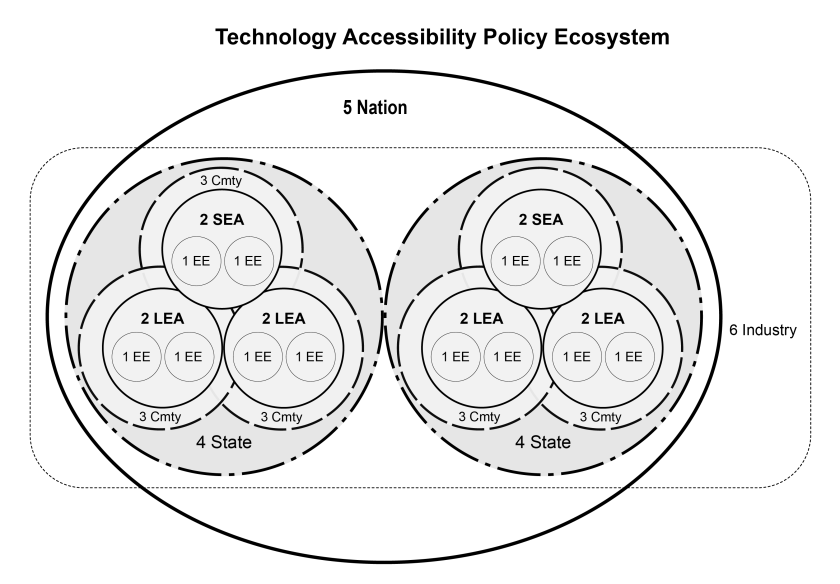
3.2 Mediating Factors
3.2.1 Highlights
| Ecosystem Level | Factor | Data |
|---|---|---|
| 1. Employee | 1.3 Not ‘know[ing] who needs to be at the table’ | “I never really quite know who needs to be at the table… I send information to people, and then ultimately, they’re not the right people. And so, sometimes we can have a delay.” (Sarah, Executive Director of Special Education, Gibson) |
| 2. Education agency | 2.5 Discovering Accessibility Collaborators | At State Department of Education 2, when Jason, Susan, and April found one another and started collaborating they were finally able to start “turning the battleship” (Susan, Digital Accessibility Specialist, State Department of Education 2) and accelerate the technology accessibility policy enactment process. |
| 3. Local community | 3.1 Parent Advocacy | “I feel like the majority of this [accessibility] work did start beginning of this year when we got the [parent] email. And then we started to work with our different departments.” (Libby, AT Specialist, Hawthorn) |
| 4. State | 4.4 SEA and LEAs Entangled Enactment Processes | State 1’s relatively new open territory approach shifted the responsibility for ensuring accessibility during instructional technology procurement onto LEAs. Many LEAs in State 1 were not prepared for that responsibility. |
| 5. Nation | 5.2 New Federal Funding 5.3 COVID | State Department of Education 2’s enactment process accelerated dramatically when Jason, the Chief Technology Officer, figured out how to utilize COVID-related Elementary and Secondary School Emergency Relief funds to create a Digital Accessibility Specialist position. |
| 6. Industry | 6.2 Vendors ‘not telling the entire story’ | “if a vendor says, ‘Yes, we can do text-to-speech,’ but they don’t say, ‘Oh, you need to have this extra platform purchased and installed for all students for this to work,’ well that’s additional cost, it’s additional treatment process.” (Tim, Director of Instructional Technology, Hawthorn) |
3.2.2 All 26 Factors
| Factor | Focusing | Accelerating | Decelerating |
|---|---|---|---|
| 1.1 Close Relationships with Disabled People | ✓ | ||
| 1.2 Being an Accessibility Novice | ✓ | ||
| 1.3 Not ‘know[ing] who needs to be at the table’ | ✓ | ||
| 1.4 Resisting Accessibility | ✓ | ||
| 2.1 Limited Resources & Competing Priorities | ✓ | ||
| 2.2 Support from Administrators | ✓ | ||
| 2.3 Large & Complex Website | ✓ | ||
| 2.4 Inaccessible LMS | ✓ | ||
| 2.5 Discovering Accessibility Collaborators | ✓ | ||
| 2.6 Cost of reactive accessibility | ✓ | ||
| 2.7 Reorg of Staff/Leadership | ✓ | ✓ | |
| 2.8 Existing Inclusion Equity Initiatives | ✓ | ||
| 3.1 Parent Advocacy | ✓ | ✓ | |
| 3.2 Community Socioeconomic Status | ✓ | ||
| 3.3 Blind Student(s) Enrolling | ✓ | ||
| 4.1 Instructional Technology and Material Acquisition approach | ✓ | ||
| 4.2 New Disability Related State Law | ✓ | ||
| 4.3 New Curriculum Standards | ✓ | ||
| 4.4 SEA and LEAs Entangled Enactment Processes | ✓ | ✓ | ✓ |
| 5.1 Office for Civil Rights Complaints | ✓ | ✓ | |
| 5.2 New Federal Funding | ✓ | ||
| 5.3 COVID | ✓ | ✓ | |
| 5.4 National Accessible Educational Materials Center State Cohort | ✓ | ✓ | |
| 6.1 Vendors not valuing accessibility | ✓ | ||
| 6.2 Vendors ‘not telling the entire story’ | ✓ | ||
| 6.3 Web Vendors Independently working on accessibility | ✓ |
4. Conclusion
- Technology accessibility policies are enacted in a dynamic ecosystem comprising six interrelated levels and at least 26 factors
- Coalitions of stakeholders must employ ecological approaches to
- implement stopgap measures
- support SEAs and LEAs in enacting technology accessibility policies
- leverage other coalitions’ knowledge
5. Acknowledgements
The contents of this document were developed under a cooperative agreement with the US Department of Education, #H327Z190004. However, the contents do not necessarily represent the policy of the US Department of Education and you should not assume endorsement by the Federal Government.
 Natalie L Shaheen